

CHARLEVOIX LIGHTHOUSE UNDER LAKE MICHIGAN GAIL (1887)

𝐃. 𝐒. 𝐖𝐚𝐲’𝐬 𝐋𝐚𝐧𝐝𝐦𝐚𝐫𝐤 𝐒𝐡𝐨𝐨𝐭 𝐨𝐟 𝐂𝐡𝐚𝐫𝐥𝐞𝐯𝐨𝐢𝐱’𝐬
𝐋𝐢𝐠𝐡𝐭𝐡𝐨𝐮𝐬𝐞 𝐮𝐧𝐝𝐞𝐫 𝐆𝐚𝐥𝐞 𝐖𝐢𝐧𝐝𝐬
September 7, 1887
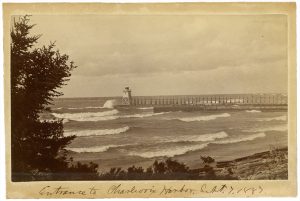
On September 7, 1887, as a heavy gale rolled in over Lake Michigan, Daniel S. Way carried his wood‑box camera and a kit of 5×8 dry‑plate glass negatives to the beach south of Charlevoix’s lighthouse pier. Working against the rising wind, he made four remarkable exposures — among the earliest, if not the first, known local photographs of Charlevoix’s original regulation lighthouse, pictured during a rising storm as heavy waves were breaking against the twin piers. Erected on the north pier in August 1885, the structure was then only two years old.
Way was the first local photographer to produce storm photographs at the lighthouse, a technically demanding and artistically groundbreaking effort with 1880s dry‑plate equipment used in the field — and the beginning of a pictorial tradition that continues today.
Way (1843–1899), a former ship’s captain, opened Charlevoix’s first long‑standing photography business on Bridge Street around 1882. His “instantaneous” outdoor views chronicled the harbor, vessel traffic, Round Lake’s development into a major port, and the town’s emergence as a regional commercial center and lively resort destination. Local newspapers followed his fieldwork closely, noting that his views showed Charlevoix as a place of striking scenery and growing appeal — a message that was carried wherever and as far as his photographs traveled. His professional work, including fine studio portraiture, continued into the 1890s.
—Charlevoix Journal, September 22, 1887
Technical Details
Date of original exposure: September 7, 1887. Shot with a portable, tripod-mounted wooden box camera with a fixed focus lens and an instantaneous field shutter. Exposed on 5 × 8 inch dry plate glass negatives in the field. Contact printed in the studio on photographic paper. Finished albumen prints mounted as 5 × 7 inch cabinet cards for widespread commercial sale. Original prints and related glass plate negatives preserved at the Museum at Harsha
On this page, we explore how new digital tools can be creatively used to interpret and reimagine historic images, offering fresh ways to visualize and deepen our understanding of the past. Inspired by archival photographs from the Museum’s collections and guided by historical knowledge, these interpretations reach beyond the limits of what can be directly seen to suggest what might have been. They invite you to explore the past with curiosity, openness, and a sense of discovery — and we hope you find them as intriguing as we do.